Get 20% off this month when you try our services!

INDOGENOUS PEOPLES
their
STRUGGLES to SURVIVE
in
MOVEMENT and COLOR
Fine Art Prints
on canvas or paper
Custom sizing available
Get 20% off this month when you try our services!
INDOGENOUS PEOPLES
their
STRUGGLES to SURVIVE
in
MOVEMENT and COLOR
Fine Art Prints
on canvas or paper
Custom sizing available
Louis Tavelli (1914-2010) was multitalented: a professional painter and musician. He played violin and viola with chamber music groups and symphony orchestras, and exhibited his paintings at art galleries and universities. He grew up in Williamstown, Massachusetts, and started playing stringed instruments when he was nine years old, encouraged by his musician mother. He soon became interested in painting as well, and studied at several schools, including the Art Students League in New York, while performing professionally as a musician.
In his early twenties he was living in the art colony at Woodstock, New York, and showing his works in local art institutions and galleries, in the company of prominent Woodstock artists. His paintings from his early years are not known, but a blurry newspaper photograph of a Mother and Child painting suggests that he was working in an abstracted Cubist representational style, as were other progressive artists in Woodstock at the time (Fig. 1). In January 1942 he married Edna Blackwood; Woodstock artist, Manuel Bromberg, and his wife were the witnesses. Edna worked for some time at the Woodstock Artists Association, coordinating exhibitions for this organization which had been founded by artists in 1919. The couple purchased land on the Maverick, the bohemian artist colony by Woodstock created by Hervey White in the first decade of the Twentieth Century, where many artists still resided. In 1954 their daughter, Gina, was born.
Shortly after he married, Tavelli was drafted into service during World War II, and served four years in the United States. He formed a string orchestra at an army base in Louisiana, and finished his service in mid 1944. Years later, in one of his few recorded statements, he reminisced that he had missed the Abstract Expressionist art revolution: “I wasn’t there. I missed it, you see. When I got out, then it was almost over. I caught the tail end of it and I was influenced by that.”
The major Abstract Expressionist artists associated with Woodstock were Philip Guston and Bradley Walker Tomlin, and Tavelli’s paintings of the 1960s reflect their innovative styles. He took Guston’s format of wavy horizontal brushstrokes floating in the middle of delicately hued surrounds and reinterpreted the older artist’s characteristic salmon, orange, pink and grey colors into greens and blues that evoke misty landscapes or seascapes (fig. 2). As he stated in the catalog of an exhibition of his works at the University of Michigan Museum in 1960, “My point of departure has been partly a remembered landscape (sky, sea, atmosphere, etc.) and partly the substance of paint itself as a sensuous, synthetic, pliable material.”
Tavelli also painted a series of canvases that relate to Tomlin’s well-known late paintings of bands of color floating on painted fields, but often in a bigger format, with dramatically simplified colors, frequently just black, white, red and blue, perhaps suggesting the flag of the United States shattered and reassembled (fig. 3). As often in his work, the paintings evoke a form of visual music, with broadly brushed rectangular strokes and shapes creating rhythms that vary from relaxed to agitatedly syncopated. Over time he started to relax these complex networks of forms into less dense graphic images, creating calligraphic human figures reminiscent of late works of Paul Klee, another painter intimately involved with music (fig. 4).
The 1960s and 1970s were periods of change for Tavarelli. Around 1960 he had a nervous breakdown, and moved back to Williamstown, though he continued to visit Woodstock and occasionally exhibited there. He taught art at various schools, while continuing to professionally perform music. 1983 was a breakthrough for his art: while touring Spain with a chamber music group he visited the Paleolithic caves in Altamira. The wall paintings, among the earliest known to be made by man, had a tremendous impact on his art. Back in the United States he returned to painting recognizable figures: hunters with bows and arrows, and their prey, cows and bulls, echoing the hunting scenes represented on the cave walls by Paleolithic artists tens of thousands of years ago. One of his paintings of a bull is rendered with slashing black and turquoise strokes against a white ground, set against a thickly textured yellow and orange surround that evokes a rugged cave wall (fig. 5).
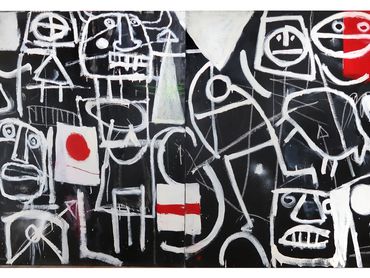
Tavelli’s figures were rendered quickly and flatly, extending the vocabulary of his Abstract Expressionist works to render passionate images that belong to a tradition that extends from Jean Dubuffet’s primitivism through A. R. Penck to Michel Basquiat’s raw representations of the human figure that were contemporaneous with Tavelli’s (although Basquiat was almost fifty years younger), to the flattened humanoids recently painted by Richard Prince. In Tavelli’s case their deliberate crudeness might have been an expression of his struggling with a drinking problem that led to his divorce. Some images feel angry or threatening, like a quartet of men painted with thick white strokes against a black background, all frontal, brandishing weapons and staring at the viewer with bared teeth (fig. 6). A head from 1988 is painted with red and black Pollock like drips that careen across the surface while crudely defining a toothy visage (fig. 7). Another is drawn with quick, thick strokes that fill the space with multiple outlines suggesting an unstable personality, while the figure’s spikey hair shoots energy all around (fig. 8).
These disturbing images of men were relieved by large collages, more cheerful scenes of musicians, reflecting Tavelli’s other career. The rendering of the figures is still deliberately primitive, but the compositions are jauntier than the hunters or single heads. The colors are more varied and nuanced, suggesting that the artist still found some sociability and joy performing with his fellow musicians. Tavelli had a long career as a painter and his work evolved steadily, culminating with the dynamic and heartfelt figures he created in his later years.
by Tom Wolf
Professor of Art History at Bard College
Curator of the Permanente Art Collection of the
Woodstock Artists Association & Museum
Woodstock, New York












.jpg/:/rs=w:370,cg:true,m)
.jpg/:/rs=w:370,cg:true,m)


.jpg/:/rs=w:370,cg:true,m)
.jpg/:/rs=w:370,cg:true,m)
.jpg/:/cr=t:0%25,l:23.82%25,w:52.35%25,h:100%25/rs=w:370,h:493.3333333333333,cg:true)
.jpg/:/rs=w:370,cg:true,m)
.jpg/:/cr=t:0%25,l:0%25,w:100%25,h:100%25/rs=w:370,cg:true)
.jpg/:/rs=w:370,cg:true,m)
.jpg/:/cr=t:0%25,l:0%25,w:100%25,h:100%25/rs=w:370,cg:true)


